The 8 Journey Zones
The zones map where a person stands in their spiritual journey — not their knowledge or their achievements, but the terrain they're on. A person occupies one zone at a time, and movement through them runs forward and back.
The Inner Garden
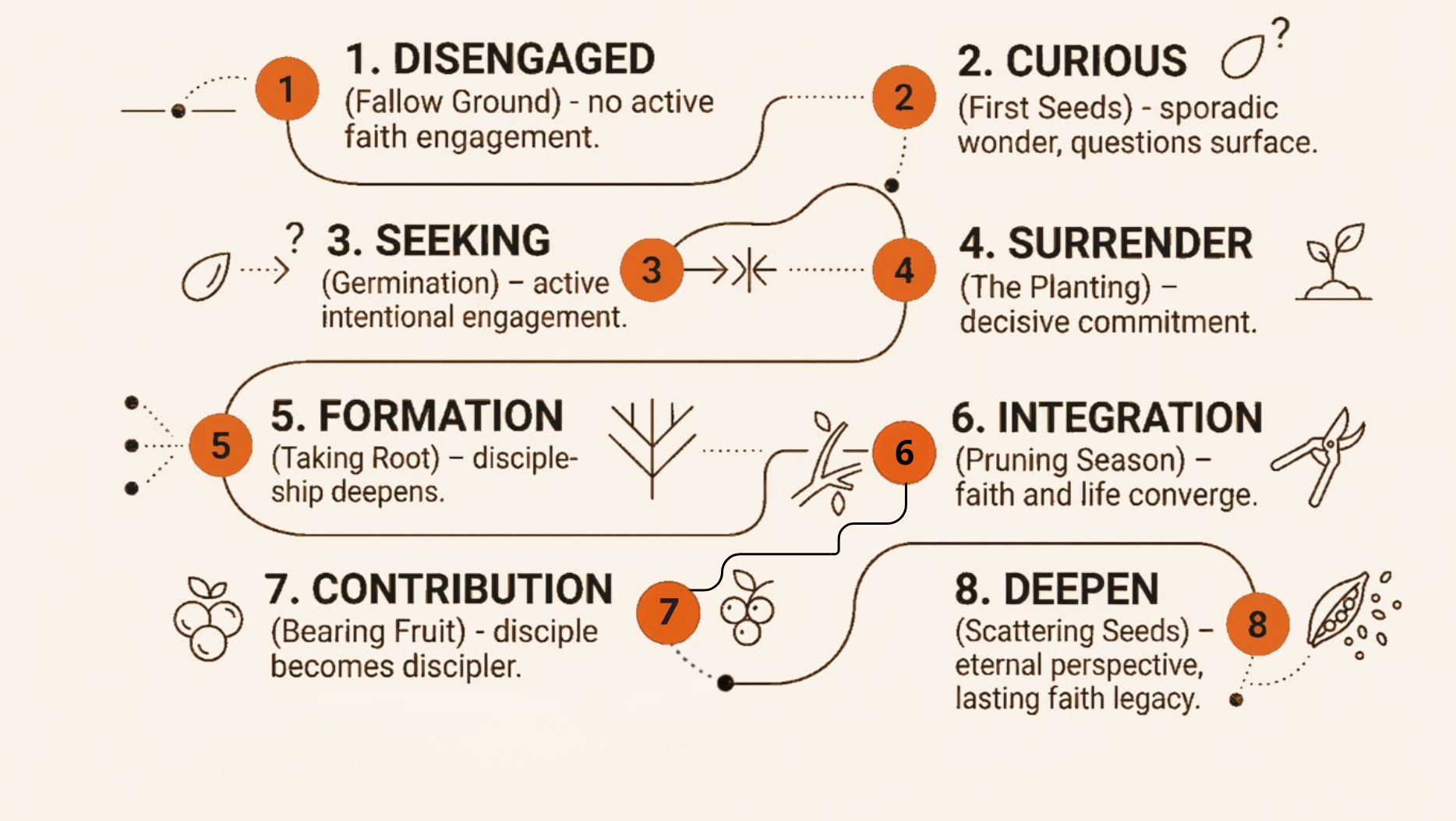
The Inner Garden — an intuitive visual overview of all eight zones as a single growing arc
Disengaged
No active connection to faith — unaware of it, indifferent to it, or set against it.
Disengaged describes a person with no active connection to Christian faith — unaware of it, indifferent to it, or set against it. It ranges from someone who has never encountered Christianity to someone who has considered it and rejected it. What they share is the absence of any live pull toward God.
Two patterns appear, and they look different. One is marked by absence — little or no religious practice, faith rarely coming up, mild disinterest rather than opposition. The other is marked by resistance — distrust, avoidance, or open hostility, often traceable to a past wound or a settled objection. In both, there’s no self-initiated exploring.
Movement out of Disengaged is relational before it’s intellectual. A genuine friendship with a Christian who doesn’t push, a disruption that unsettles self-sufficiency — loss, illness, a major life change — or an unguarded encounter with faith can open the first crack of curiosity. Trust, not argument, is what moves a person here.
This is the longest plateau in the journey — a person can remain here for decades. The most common mistake by those hoping to draw them forward is pushing faster than trust has been built: pressure, judgment, or hypocrisy hardens indifference into resistance, and where there's an old wound, confrontation deepens it. A person can also arrive here by falling back, sometimes into renewed hostility, though those who had gone further often re-enter later at Curious or Seeking instead.
The shift toward Curious is a shift from not noticing to noticing — a first question, a first willingness to listen, an opening where there was none. It’s rarely a decision so much as a lowering of the guard: faith becomes, for the first time, worth a second look.
Curious
A passive, general openness to spiritual questions, not yet focused on Christianity in particular.
Curious describes a person who’s moved from indifference to a tentative interest — real but broad, often a general spiritual curiosity rather than a focus on Christianity specifically. A person here will listen, ask the occasional question, or accept an invitation, while keeping a clear line between being interested in faith and identifying with it.
The posture is openness without commitment. Much of what’s happening is trust evaluation: less an examination of Christianity’s claims than an assessment of whether Christians are credible and whether there’s room here for someone like them. Identity hasn’t shifted — “I’m interested in this” hasn’t become “this is mine.”
The quality of the relationships a person is meeting carries the most weight — faith becomes plausible when it’s seen lived credibly in someone they trust. Safe room to raise questions without pressure helps, as does honest engagement with the barriers real for them. The threshold into Seeking is crossed relationally more than intellectually.
The characteristic risk is a long plateau — curiosity extending for months or years without deepening, especially where faith can be consumed anonymously, at a distance. Without a human bridge, consumption stands in for community rather than leading toward it. Pressure works against movement too: a commitment requested before trust is there closes the opening rather than widening it.
The shift toward Seeking is a shift from passive to active — from receiving it when it comes to pursuing it deliberately. General spiritual openness narrows into a specific pursuit of Christianity’s claims, and questions turn personal — no longer “this is interesting” but “I need to know whether this is true.”
Seeking
Curiosity turns into intentional pursuit, and the search narrows specifically toward Christianity.
Seeking describes a person whose interest has sharpened into active pursuit. Where Curious was broad and tentative, Seeking is focused and self-directed: the person investigates Christianity’s claims for themselves and weighs what following Christ would mean. This is the pre-conversion season of counting the cost — drawn toward a decision while still working through the questions and fears in the way.
The mark of Seeking is initiative: a person reads, asks, and attends on their own, and experiments with prayer or practice, however tentatively. The questions turn practical and personal — “what would I have to change?” It’s an emotionally charged stretch, where conviction that “this is true” sits alongside anxiety about what saying yes would cost.
A seeker needs clear guidance toward the decision they’re moving toward. Honest, unhurried conversation about the real barriers — pride, fear, what family will think, a doctrinal sticking point — does more than argument here. Direct invitation belongs at this stage, offered at the moment of readiness rather than forced early.
Seeking is the most volatile zone in the journey, and the risk rises the longer it stays unresolved. Urgency that goes unmet tends to dissipate, and a person can drift back toward Curious or further. A poorly timed push works against movement too: pressure applied too early provokes resistance, and a disappointment or offense at a decisive moment can stall the search or reverse it.
The move toward Surrender comes as the inner tension resolves — the remaining questions settling behind the pull of the decision, and readiness replacing hesitation, often felt as peace rather than certainty. It shows in decision language (“I’m ready”), in responsiveness to an invitation, and in first concrete steps toward committing publicly.
Surrender
Yielding to Christ in conversion — sometimes a single decision, sometimes a longer process of committing.
Surrender is the point of conversion — where a person yields to Christ, trusting him as Lord and turning to follow. It can be a single decisive moment or a shorter process of committing, and by design it’s brief: the crossing from seeking into new life, followed quickly by the early growth Formation takes up.
There’s usually an identifiable decision — a prayer, a public profession, a request for baptism — followed by quick, visible change in habits, language, and priorities. The emotional signature is “first love”: joy, relief that the tension of seeking has resolved into peace. Alongside the confidence, a new believer often carries uncertainty — “did it really take?” or “what now?”
The decisive factor is quick, genuine integration into a church — a person converted in a crowd but left to navigate alone rarely goes on. Assurance established early matters as much: helping a new believer rest in grace so they aren’t unsettled by feelings or a first failure. A mentor present, and baptism as a public marker, help the decision take root before the first fervor fades.
The season just after conversion is among the most fragile in the journey. Enthusiasm alone is no guarantee — it can spring up fast and fade just as quickly without roots. Isolation is the central danger: a new believer left without community in the first weeks often drifts back. Shame at ongoing struggles, family rejection, or a legalistic welcome can compound it.
Movement into Formation shows as the first fervor settling into rhythm — enthusiasm turning into steady habits of prayer, Scripture, and gathering, alongside a hunger to grow (“how do I go deeper?”). The conversion identity stabilizes: “I just decided” becomes the settled “I am a follower of Christ,” and the first steps of obedience follow.
Formation
Laying the foundations of discipleship: new habits, a Christ-shaped identity, and working out why to follow Jesus.
Formation is the season of early growth after conversion — the foundations of discipleship being laid. A new believer learns the basic practices and truths of the faith, builds spiritual habits, and forms an identity shaped around Christ. This is spiritual childhood: a stretch of intensive learning where the worldview is rebuilt and the person works out, at ground level, why they follow Jesus.
The posture is teachability. A person in Formation is eager to learn, receptive to guidance, and building regular rhythms — prayer, Scripture, gathering, early attempts at serving. Faith is becoming central to how they understand themselves. Convictions at this stage tend to be adopted from trusted leaders more than personally worked out.
Formation needs structure in the basics — foundational teaching, and a mentor who meets regularly to answer questions and model the walk. Habits take deliberate building: enjoyable on-ramps into prayer and Scripture, paired with accountability. Small chances to serve move a person from receiving to participating. Sound teaching matters especially here, since convictions are still largely taken on trust.
The great risk of Formation is a permanent plateau — a large share of committed, active churchgoers settle here and quietly stop growing. They attend, serve, give, and believe the right things, yet never move into a personally examined faith. The mistake that sustains it is reading activity as maturity: the most active members are assumed to be the most mature, and so are never invited further. Legalism and isolation stall growth too.
Movement toward Integration begins when a person starts to own the faith personally — prescribed routines giving way to conviction and self-directed practice, and harder questions surfacing from a hunger for depth rather than doubt. A first real test — suffering, doubt, or conflict — weathered without falling away is a strong marker, as is growing independence from leaders.
Integration
Faith is tested and personally owned, integrating more deeply as a person works out how to follow Jesus.
Integration is where faith moves from inherited to owned. A believer stops holding the faith mainly on others’ authority and begins working it into every part of life — reconciling belief with doubt, vocation, and hard experience. Where Formation asked why follow Jesus, Integration asks how: how faith holds up under pressure, and how it reshapes life as a whole.
The mark is a faith under examination: asking “why” more than “what,” dissatisfied with easy answers, able to sit with unresolved questions. Many pass through a season of dryness or God’s felt absence yet hold on. Visible church activity sometimes dips while private practice deepens. The clearest tell is a growing distinction between the faith a person was handed and the faith they now hold.
Integration calls for accompaniment more than instruction — a mentor or spiritual director who asks good questions and points toward God in the ambiguity rather than supplying answers. Room to voice doubt without alarm, and permission to sit in the hard middle, matter most. Through the Wall — when old practices stop working and God seems absent — what carries a person is not technique but encounter, and someone willing to stay present.
The dryness and sense of God’s absence described here are a recognized part of this passage — but they are not the same as clinical depression, which is a medical condition. The two can look alike and can overlap. Accompaniment matters, and so does knowing when to encourage professional care.
This is the costliest plateau in the journey. Left unaccompanied, the Wall can lead to a deconstruction that never moves on to reconstruction. The danger compounds because the passage asks for patient presence rather than programming — the first thing most communities lack. A person met with alarm at their doubt, or left alone in it, is the one most likely to stall or exit.
Movement toward Contribution comes as the Wall resolves — God encountered in the darkness, not merely survived. A settled sense of calling forms, no longer generic duty but a particular way this person is meant to serve. Identity steadies, and doubt loses its power to destabilize. The energy that turned inward for a season turns back outward, felt as a pull to give.
Contribution
A maturing faith turns outward, investing in others through gifts, service, and leadership.
Contribution is where a settled faith turns generative. Having been built up, a person now pours into others — serving, leading, mentoring, and helping others along their own journeys. The focus shifts from personal depth to outward impact: identifying spiritual gifts and using them, and investing in people rather than only performing ministry tasks.
The mark of Contribution is a life organized around calling. A person here is discipling or leading, not just attending, and makes real decisions — career, time, location — with kingdom purpose in view. Gifts are identified and used in sustained ways. There’s a mission-centric outlook, a distinct joy in seeing others grow, and often a willingness to step out of the spotlight so someone else can rise.
Though a person here can look self-sufficient, the support that sustains them is real. Leadership development sharpens skills; peers who lead prevent the isolation ministry breeds. Ongoing mentoring still matters, even for the experienced. Most of all, this stage needs care for the person beneath the role — rest, boundaries, and rhythms that guard against burnout, so serving flows from a full life rather than draining one.
The characteristic dangers here come from within the work itself. Burnout is the constant threat — output outrunning what sustains it, until service empties the one giving it. Pride is the quieter one: fruitfulness hardening into self-importance, or ministry becoming an identity a person can’t rest from. Isolation compounds both. A person can also plateau, mistaking a busy season of activity for growth.
Movement toward Deepen turns on a paradox many resist: going further means stepping back. It shows as a shift from personal achievement to making room for others — raising up successors, releasing operational roles, caring more that others increase than that one’s own work continues. A lengthening perspective often accompanies it: a sense of life’s brevity, and a desire for what’s built to outlast the builder.
Deepen
A deep, settled intimacy with God, marked by discernment, quiet fruitfulness, and wisdom often forged through suffering.
Deepen is the most mature season of the journey — not the accumulation of influence, but the deepening of the interior life. It’s marked by a settled intimacy with God, spiritual discernment, and a quiet fruitfulness that no longer depends on being seen. The intimacy with Christ here has usually been shaped by suffering, showing as unhurried wisdom and a deep conviction to pour into others.
The mark of Deepen is depth without display. A person carries a peace that circumstances don’t easily shake, and a discernment others come to rely on. Wisdom is evident, often plainly tied to what they’ve suffered and come through. Fruitfulness continues but grows quieter — less visible output, more presence, prayer, and the steady shaping of others.
Even here, growth isn’t self-sustaining. What deepens a person most is continued communion with God — the disciplines of silence, prayer, and attentiveness that keep intimacy alive. Meaningful relationships that receive as well as give matter, as does honest companionship that doesn’t defer simply because a person is seasoned. Suffering, when it comes, often does the deepest work, and what helps is presence within it rather than relief from it.
The risks here are quieter than in earlier zones, but real. One is disengagement — mistaking maturity for arrival, and slowly withdrawing rather than deepening. Another is holding on — clinging to position or influence when the season calls for release, so that what should ripen into freedom curdles into control. And because this stage draws so much from suffering, unmetabolized pain can quietly stall the very depth the zone is meant for.
Deepen is the final zone of the journey as the framework maps it — there is no further stage to move toward. What continues is the deepening itself: intimacy with God grows, others are formed through them, and wisdom continues to settle. The journey’s telos — union with God and transformation into his likeness — is not a destination reached and left behind but the direction life as a whole now leans, until it is complete in God’s presence.